Here is Brownie’s complete chapter —
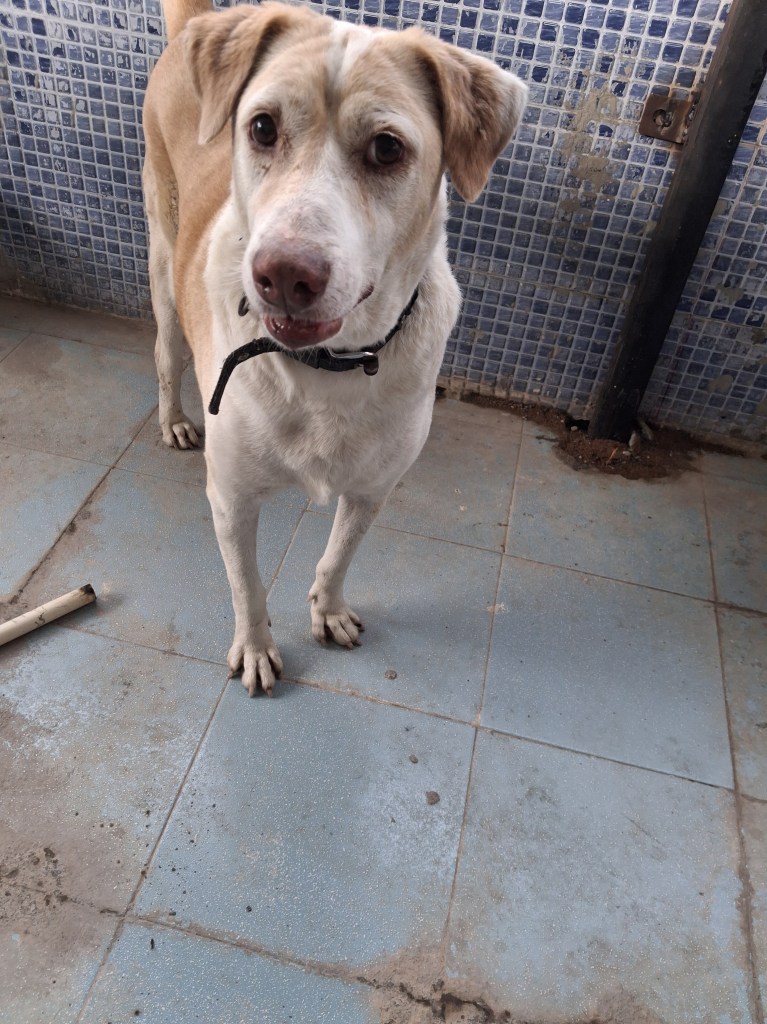
He arrived because my sister had asked.
She had requested the school watchman to keep an eye out for a pup — and one day he came carrying a young brown and white dog, beautiful even in his weakness. How old exactly, we never knew for certain. Young, perhaps eight months, perhaps a little more. In Golconda, where street dogs rarely survived human attention, this one had been noticed. Carried. Delivered.
She said yes immediately. She always does.
But we already had five dogs at home. There was no space, no way to bring him in. So the school became his home instead.
He never seemed to mind. Some souls simply bloom wherever they are planted.
The school grounds became his kingdom. During school hours he stayed in his kennel, patient and unbothered, and when the children left and the gates quietened, the whole ground was his. He ran it daily for years. That exercise, we believe, is what lives in his bones even now — why at above nineteen he still moves, still chases, still runs off with slippers when the biscuit is delayed.
A Marie biscuit was never optional. From the very first day, whenever any of us visited, one biscuit was produced. It was not a treat. It was an understanding between Brownie and the universe, and the universe has always complied.
Then Celina arrived.
She simply walked in one day — a street dog, smart and beautiful — and my sister began feeding her. What we didn’t realise was that Celina had already decided she lived there. She would regularly escape over the school wall — eight and a half feet of compound wall — as casually as stepping over a threshold. An escape artist, a free spirit, entirely her own creature. We wanted her as Brownie’s companion. He was already neutered. We thought we knew what we were doing.
We did not.
In 2019 Celina gave birth to a litter of eight. The school grounds, Brownie’s quiet solitary kingdom, became overnight a raucous, tumbling, completely chaotic nursery. Celina, true to her nature, had clearly been using those wall-jumping expeditions for more than just sightseeing. Of the eight, three survived. And those three — Jack, Luke, and Daffodil — are with us still.
Brownie, to his enormous credit, did not complain. He simply accepted new additions to his kingdom and found new life in the mayhem.
Then the goons came.
The school at Golconda was not ours by ownership. It never had been. The property belonged to a man named Sheetal Patel, who had approached my father with a vision — run a school for children from economically weaker sections, on this land, in this skeleton of a building. My father said yes. He always said yes to the right things. They built a structure and he was very happy to start an institution. We always assumed the land was theirs. Several years later, he found out that the land was under dispute — the school had been running for years by then, with rent paid every month as agreed.
What followed was 31 years.
31 years of every rupee beyond salaries going back into the building. Classrooms constructed. Infrastructure developed. Property tax paid — in the school’s name — year after year. The owners contributed nothing beyond the original walls. We built everything else. In the final years alone, four new classrooms rose from our own savings. Twenty lakhs. Because the children needed space and that was simply what you did.
Brownie had lived through all of it. He had watched the school grow around him, watched my father’s dream take shape brick by brick, watched my mother — a correspondent, a tigress, a woman who did not know the meaning of giving up — hold it all together for three decades alongside him.
Then one day, after my father’s death, men walked in saying they had purchased the property from the owners years ago and had now won the litigation. The rent they demanded was 15 lakhs a month — for a school whose entire fee collection, if every single family paid without default, would amount to roughly 11 lakhs a month. That never happened. It never does in a school like ours.
Of that 11 lakhs, 8 to 9 lakhs went directly to teachers’ salaries. What remained had to cover everything else — maintenance, development, the slow brick by brick building of something real.
We offered two lakhs. Double what we had been paying. Knowing it would stretch us. Knowing we would have to go back to parents with another small increase as we did every year — and those increases had always been gentle. Rs. 10 or Rs. 20 in the early years. Never more than Rs. 100 or Rs. 200 as the years passed. The highest monthly fee any child paid across 31 years of this school was Rs. 1800.
We were not running a business. We were running a promise.
They wanted 15 lakhs. We offered two. They were not interested.
These men had political clout. AIMIM connections. One of them spoke openly about breaking people’s hands and legs and seemed proud of it. We filed an FIR. The police were friendly with the other side.
Every part of me wanted to fight. We would not have lost — 31 years of an institution, tax records in the school’s name, a community built from nothing. The case was ours to make. But cases take time and goons don’t wait for courts. They work in smaller, darker ways — through disgruntled neighbours, through pressure on parents, through a hundred small battles designed to exhaust you before the big one even begins.
And there were the dogs. And there was my mother.
She didn’t want to let go. She is not built for surrender. But I could see what the stress was doing to her body, her sleep, her face. I could see the price she was paying simply by staying in the fight. And I knew — I would give up the school before I gave up her health. I would give up the building, the classrooms, the 20 lakhs, the 31 years, before I put her or those dogs at risk from men who had already told us exactly what they were capable of.
So I pushed her to let go. I took that decision onto myself. If that makes me a coward, I have made my peace with it.
We left at the end of that academic year.
In February 2025, we built kennels on our terrace. And Brownie — who had known no home but those grounds for nearly two decades — came to us at last.
He walked in like he had always known this was where he was meant to end up.
Maybe he had.
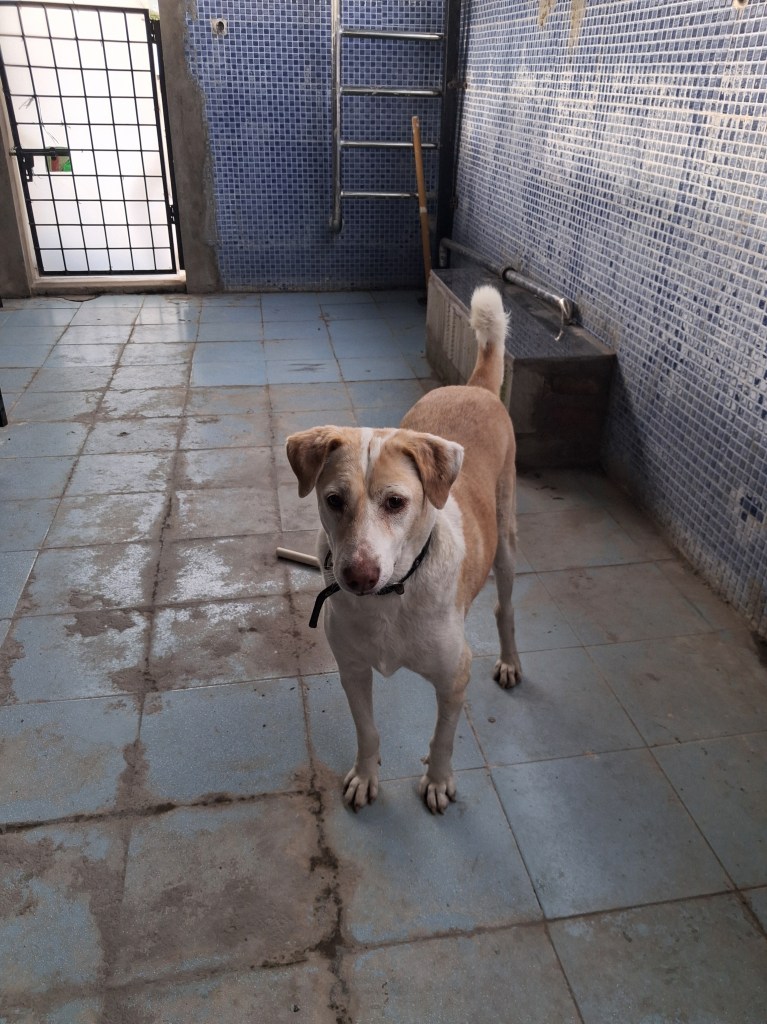
He is above nineteen now. Maybe more. Nobody really knows where he began.
What we know is this — he lost his kingdom and didn’t grieve it. He arrived on a terrace with six kennels and a used mattress and a woman who slept beside him for several nights so he wouldn’t be afraid, and he simply… continued. The sesame oil massages on his hind legs. The hemp oil. The eye drops for eyes that see the world a little softly now. The toothless grin that is somehow more endearing than any expression I have ever seen on any face. The slippers he still steals when the biscuit is delayed. The ankles he still bites to remind you of your obligations. The plastic bottle he has claimed as his most prized possession — no fancy toys, no imported balls, just a bottle and the absolute certainty that it belongs to him.
He has taught me that nothing in life is permanent. That a place is just a place. That home is the people who show up, who stay, who sleep beside you in the dark until you understand you are safe.
He has taught me to roll with life. To find your joy wherever you are planted. To not waste a single day mourning the ground you lost when there is a perfectly good terrace right here with your name on it.
And he has taught me — perhaps most importantly of all — that even the longest journey can be lived happily.
As long as the Marie biscuit arrives on time. 🍪
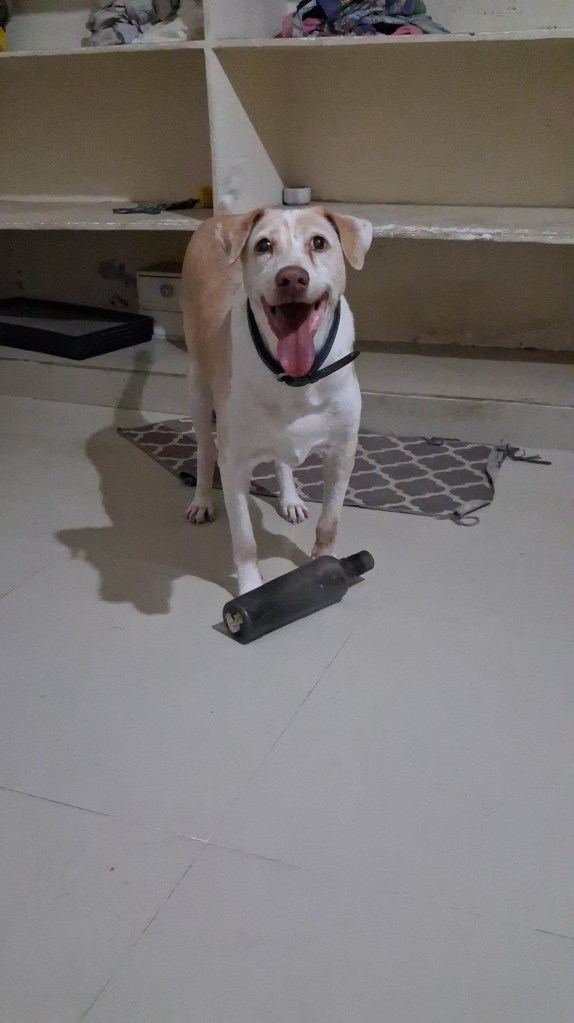
That’s Brownie. The one who knew first. The one who stayed longest. The one who taught us that home was never the building. 🐾🙏
 thedharmatails